Huggingface
100+
Hours
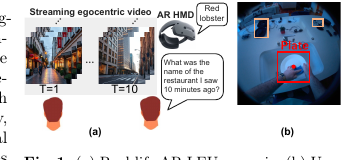
Long-context egocentric AR video
Full paper
Preview PDF

A Benchmark for Human Behavior–Inspired Long-Context Egocentric Video Understanding in AR Environment
Grounded in gaze traces, long-context egocentric video, and carefully
reviewed multiple-choice QA for
evaluating practical AR assistants.
1New York University 2Meta Reality Labs
† Equal contribution. ‡ Corresponding author.
Long-context Egocentric Videos
02 / Dataset
EgoEverything is a benchmark for long-context egocentric video understanding in AR environments. It leverages human attention signals abstracted from gaze data to generate natural multiple-choice questions, covering over 5,000 QA pairs across more than 100 hours of video.
100+
Long-context egocentric AR video
5,000+
Multiple-choice memory and reasoning pairs
Real
Human attention signals aligned to video
8
From recall to spatial-temporal reasoning
28
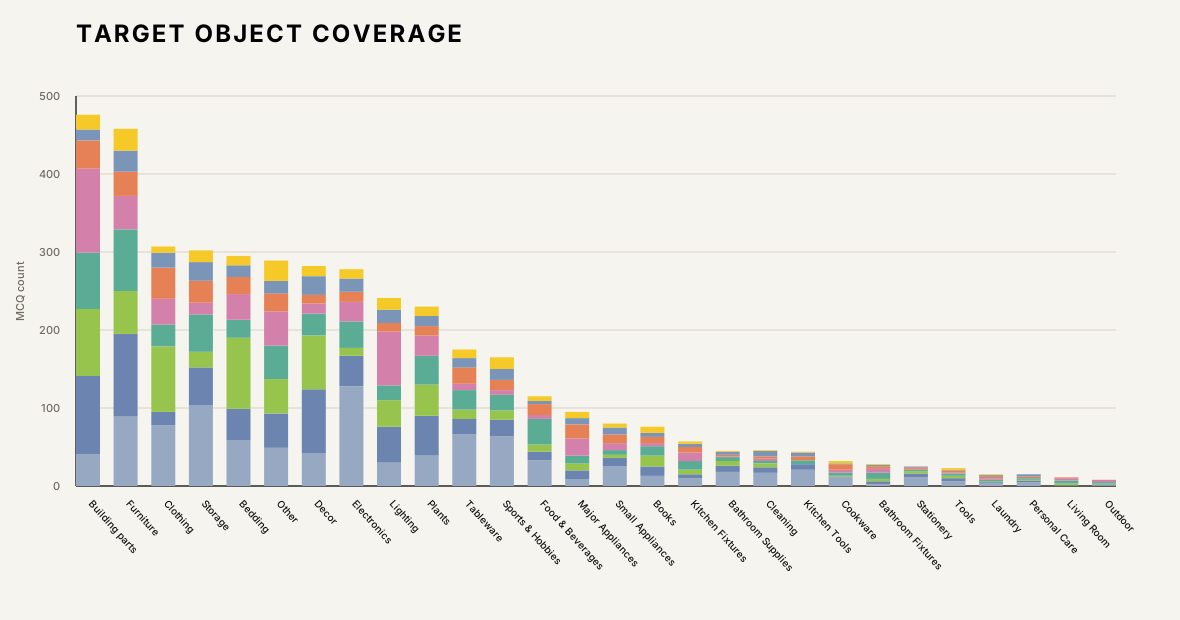
Fine-grained targets in everyday scenes
400+
Human validation and benchmark curation
Existing long-context egocentric benchmarks often ask generic, template-like video questions and overlook how AR users naturally query what they attended to during interaction. EgoEverything fills this gap with gaze-grounded, human-reviewed MCQs that better reflect real AR memory and reasoning needs.
Question type distribution
Percent share across EgoEverything MCQs.
Target object coverage
Question coverage
Temporal-Spatial
when + where
Spatial-Spatial
relative layout
Appearance
visual attribute
Item Presence
object exists
State Verify
state check
Event Verify
event happened
Direct Location
absolute place
Others
miscellaneous
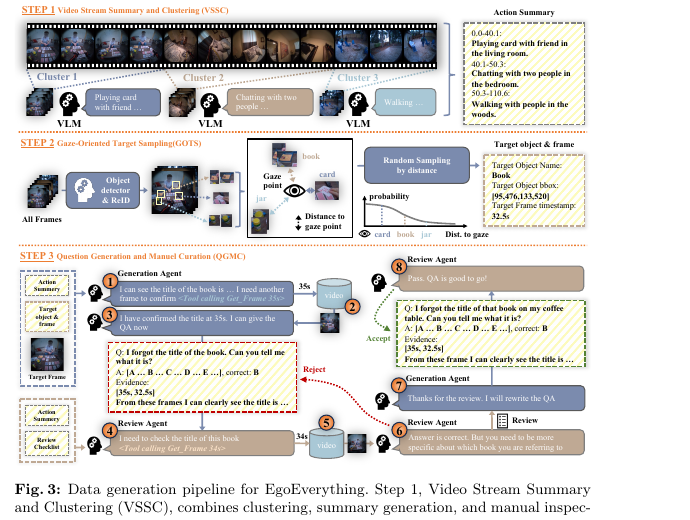
EgoEverything turns long first-person video and gaze into compact, reviewed MCQs through a gaze-oriented target sampling pipeline.
Start from long AR recordings with gaze traces aligned to what the wearer attended to.
Sample meaningful targets around attention patterns instead of asking generic video questions.
Turn sampled targets into multiple-choice questions and keep the benchmark human reviewed.
04 / Examples
EgoEverything examples show how a gaze-sampled target object becomes a natural multiple-choice question with supporting frames, colored evidence, and model-versus-ground-truth labels.
Figure 4 / MCQ evidence examples
MCQ examples / 8 question types
01 / 08Was there a red and white chevron blanket on the sofa in the living room?
Why Item Presence: Asks whether a specific item appears in a specified place.
The homepage preview surfaces the headline gap: strong models improve over text-only baselines, but still struggle with long-horizon visual memory, small details, and attention-conditioned evidence.
Leaderboard Snapshot
Reference performance from human review
Top evaluated vision-language model
Question-only baseline without video
83.5%
63.1%
35.9%
05 / Analysis
EgoEverything exposes systematic limitations in current VLMs: longer recall intervals, targets farther from gaze, and smaller target objects.
Performance drops as the answer depends on events farther back in the egocentric stream.
Targets away from direct gaze are easier for humans to retain than for current VLM pipelines.
Fine-grained, low-area visual evidence remains fragile even when the object is semantically simple.
06 / Citation
arXiv BibTeX for the EgoEverything benchmark preprint.
BibTeX
@misc{tang2026egoeverythingbenchmarkhumanbehavior,
  title         = {EgoEverything: A Benchmark for Human Behavior Inspired Long Context Egocentric Video Understanding in AR Environment},
  author        = {Qiance Tang and Ziqi Wang and Jieyu Lin and Ziyun Li and Barbara De Salvo and Sai Qian Zhang},
  year          = {2026},
  eprint        = {2604.08342},
  archivePrefix = {arXiv},
  primaryClass  = {cs.LG},
  url           = {https://arxiv.org/abs/2604.08342}
}